Offerings
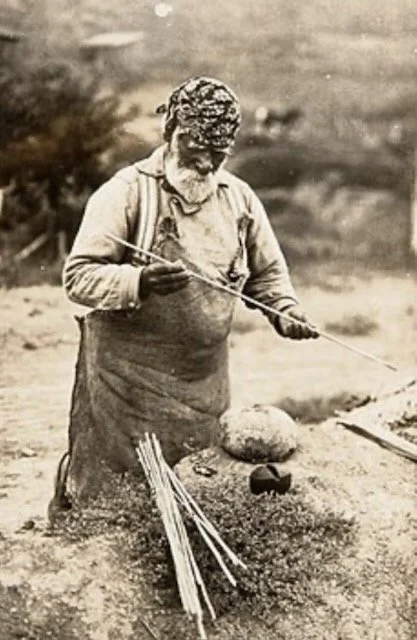
Fernando Librado
Yesterday I attended an Earth Day celebration at the local school where I was once a teacher. There were three special guests: anthropologist Paul, farmer Jacob, and Gabriel, a descendant of Kitsepawit (1839-1915), the Chumash elder and storyteller more commonly known as Fernando Librado. Fernando was the principal informant of anthropologist John Peabody Harrington, and thus helped to preserve the language, customs, and knowledge of the indigenous people who lived here for thousands of years, long before the arrival of Europeans. (I’ve written about Fernando Librado before; you can read those stories by clicking on these links: here and here.)
Our little school happens to be a short walking distance from the very cave where Fernando lived and wrote and ultimately crossed into the afterworld where his ancestors welcomed him. But before walking to the cave, we gathered in a classroom for a talk by Paul. We learned that there are millions of indigenous people worldwide, and they share the idea that the earth is sacred. In the Andes, where Paul did his field work, the term is Pacha Mama, or Earth Mother, and she is to be honored and respected.
Then Jacob spoke to us about the idea of respect, the essence of which is to look again (re-spectate). Keep looking, he said, to really see and understand. Understand: what I stand upon, what I stand for. It’s another word I had not thought about in such a literal way, but it’s important. We need to “make up our mind” he said, but isn’t making something up a form of fantasizing? I love how the borders begin to blur.
The Chumash stories are metaphorical and enigmatic. “Our Samala language is like the flower of this earth,” said the beloved Santa Ynez Chumash ancestor Maria Solares (1842-1923). This prompted thoughts about how words and ideas spread seed and grow, and sometimes bloom in beauty. The term “Flower Power” entered my mind, perhaps some silly residue of my 1960s youth, but language, in its various forms, can indeed flower, and it certainly has power.
Jacob described his feelings about plants, based on his very real, day-to-day interaction with them. “As a farmer,” he said, “I feel that my dependence on plants is a form of humility that makes me tend to them differently. I listen more.”
And he talked about connectedness, the interrelationship of all beings, including plants. Our task, he said, is to observe the ways of the world so we can be useful to future generations.
I had recently been reading poetry by Ada Limón and this fragment came to me, from one of her poems:
J said, You don’t believe in God? And I said,
No. I believe in this connection we all have
to nature, to each other, to the universe.
And she said, Yeah, God.
I believe in that connection too, and it doesn’t matter what you call it. I believe, as Rumi said, there are a thousand ways to kneel and kiss the earth. And the beauty we love can be what we do, and that too is a form of prayer. Our relationship to the planet can begin with listening and observing in wonder, then offering something back. Tending and mending, perhaps. And loving. Manifestations of love do seem God-ly.
In a recent podcast, Limón suggested this: “You can offer some small thing…. sometimes there just needs to be repair work on a very small level, that we know that we are in relationship with this place, that we are part of this place. And sometimes it can be as small as a poem. Sometimes it can be big enough to be collective action, and sometimes it's just small enough to say hello to a tree.”
So these are the things I was pondering as we went outdoors to meet Gabriel, who would lead us up the narrow brushy trail to the cave. He prefaced the walk with an introductory talk about the multi-tribal Chumash, the skills they developed with practice across thousands of years, and their reach along the coast and beyond. His pride and enthusiasm were palpable. “Maybe someday we’ll bring a tomol right here and you guys can look at it and climb in it,” he added playfully.
The campus abuts the mountains Fernando knew so well, and the old oak trees around us might well have been here in his time. I watched a pair of crows landing on a red tile roof that wasn’t there and a very blue sky that was. I heard the rustle of the beckoning backcountry behind me. I felt the anticipation of the children, and I wondered how much of this they would remember, and whether it would somehow influence the way they approached the world in the years ahead.
“And now we’re going to the cave where Fernando lived. It is where he chose to be. He had a typewriter in there, and books, and you can see the remains of its wooden door, but beware of poison oak.”
I have been to the cave a few times before, but never in circumstances like this, with a procession of children led by someone who had a direct connection to Fernando’s family and cultural heritage.
The entrance to the cave was visible through the brush and branches now. Gabriel left an offering of bundled sage inside, then sang a song in the Chumash language, keeping the beat with a clapping stick. It told the story of a time of drought when the Ancestors came to Jalama in search of food, and a pod of swordfish appeared and beached three whales. The song was one of thanks to the Creator.
The words hovered in the air, and the woody rhythmic clacking echoed, and beneath all sound, the brush was whispering. I felt prayerful.
This land has been given many names, but we are all a tribe, and we stand here remembering. We are stewards. We belong to the earth, and we belong to each other.
Lately I have felt that we are grieving great loss together, but today I remembered we are also embracing and cherishing what remains.