What You Already Know
Last night I was one of the presenters at a poetry event at a local museum. It was an intimate, uplifting gathering of gracious and receptive souls. Poetry, as W.S. Merwin said, is not something we understand; it is something we recognize. And that kind of recognition was palpable among the listeners in our audience last night.
“Most of us hold these kinds of feelings in our hearts,” said one woman to me afterwards, “but we don’t know how to express them in words. It feels so good to hear the feelings spoken.”
In the poems chosen and the informal conversations before and afterwards, there was an acknowledgement, both explicit and implied, of the dystopian nightmare in which we are immersed, but a sense of defiance and determination prevailed. I suppose art and literature have always been forms of resistance.
“It was kind of like a call to arms,” said my friend Vickie. “But also like a memorial, mourning what we have lost.”
And it was. A mournful call to arms, a slow, heartbroken one, with a persistent percussion of necessary toil, and dissonant strains of exhaustion and disillusionment, but building to a crescendo of hope. There within the circle of blessed community, we could see how powerful we are, and the words of the poets lifted us.
Then, this morning, I attended a book talk in the park, attended by the ladies of the hiking group. The book we discussed was All The Beauty In the World by Patrick Bringley, who writes about his decade as a guard in the Metropolitan Museum of Art. It prompted wonderful discussions about art, and grief, and being in the world.
“On a typical day,” he writes, “it is easy to glance at strangers and forget the most fundamental things about them: that they’re just as real as you are: that they’ve triumphed and suffered. That like you they’re engaged in something (living) that is hard and brief.”
Bringley took on the job of museum guard after the death of his beloved older brother, seeking some kind of refuge, solace, and stillness in his bereavement.
“Artists create records of transitory moments,” he muses, “appearing to stop their clocks. They help us believe that some things aren’t transitory at all but rather remain beautiful, true, majestic, sad, or joyful over many lifetimes…”
Pausing his life in the larger world outside the museum, Bringley learns to pay attention, and to think differently about time. He develops a camaraderie with his fellow guards, and above all, acquires an intimacy with the mystery and power of art, which leads to a better understanding of life itself.
“When you walk through a museum,” he says, “you’re not just looking at art, you’re moving through centuries of people trying to explain love, grief, power, beauty, and belonging.”
And, as with poetry, it prompts a recognition, it reminds us of the obvious, of the universal experiences of humanness across the centuries; it unsettles the beholder, but can also instill compassion and empathy, and perhaps a newfound realization that even the ordinary is extraordinary, and there is poetry in all of it.
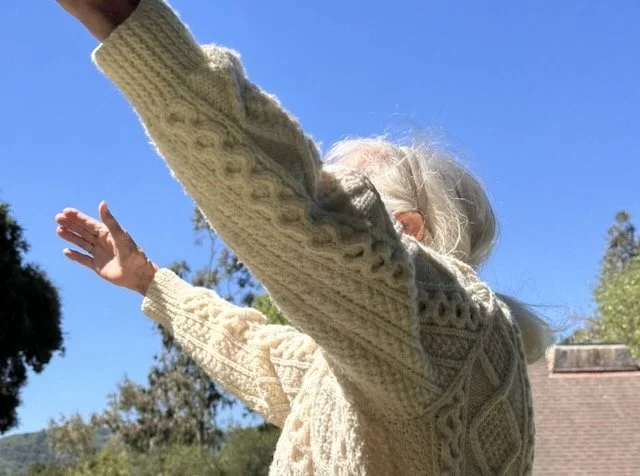
Back to the book group in the park. One of the ladies is 92 and happens to look a lot like my mother, although she has certainly led a different kind of life. (That’s her in the picture above, expressing herself.) She grew up in central New York and still has a cottage on the St. Lawrence Seaway, which she will be visiting soon, getting around solo in a rowboat, if I understood correctly. She is a Wellsley graduate, Class of ’56, and her plans this year include witnessing the total solar eclipse in Spain on August 12th, and walking a portion of Camino de Santiago, which involves a climb across the Pyrenees. Her 65-year-old son will be with her, and hopefully he can keep up. She strikes me as someone who approaches life with a bias toward the side of yes.
I so respect these readers and learners, walkers and sharers. You might have smiled to see this little circle of women sitting by the shade trees on their portable chairs, earnestly talking books. But there’s so much caring and connection here. Afterwards, I felt as I did when I left the poetry event: fortified, reassured, a little more observant and grateful.
And it occurred to me that the gathering itself was a form of art, and it fit Bringley’s description: “This is real, is all it says. Take the time to stop and imagine more fully the things you already know.”
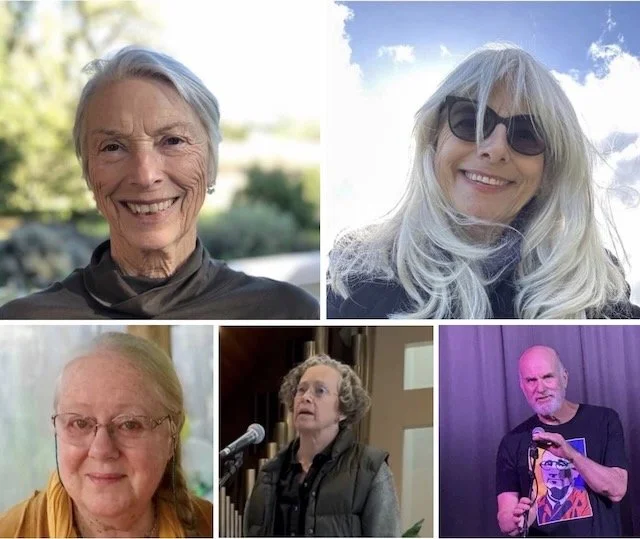
(Pictured below: the cast of Sunday’s poetry event at the museum. We adhere to Mary Oliver’s instructions: “Pay attention. Be astonished. Tell about it.”)