The Wishing Tree
If you had happened to wander through River View Park that morning, you would have seen three older women huddled together at a picnic table. They were in brainstorming mode, words coming fast and swirling about. There was sense, and nonsense, and scribbles on a notepad, and sometimes the session seemed frenetic, but this was really urgency and passion.
Because, let’s face it: the relentless assault on all we care about is scary and exhausting. The deranged and depraved are empowered, the guardrails are down, and, as if it weren’t rough enough already, we’ve now been plunged into a war.
But silence and submission are forms of complicity, and we have chosen to respond by becoming larger, louder, more courageous. “Our choice,” as the poet and essayist David Whyte has said, “is to inhabit vulnerability as generous citizens of loss, robustly and fully.”
And in this full and robust mind set, we were riffing, rambling, and searching for ideas.
We fervently believe that each of us must find a way to help, to do something(!) as opposed to nothing, to seek our lane and apply whatever abilities we each possess, and that such actions cumulatively constitute powerful resistance. These activities take a variety of forms, and even the smallest have a ripple effect, but the most potent actions occur in the context of community.
So here we were, three silver-haired women at a picnic table in a small-town park adjacent to the local botanic garden, trying to generate ideas to make visible and more effectual the community we know is here. Sometimes the suggestions were extravagant, and who would do the work? And sometimes they were silly and impractical and maybe even futile, but we were certain that this free-wheeling flinging of ideas into the air was necessary, and certainly preferable to the panic or paralysis that lies in wait.
Meanwhile, the trellis above the table cast a crisscross pattern of sun and shade, the air smelled fresh and grassy, and the strands of our voices wove themselves into a murmuring kind of music. A dog-walker passed, and a runner, and a young mom pushing a stroller. Jan is working on a song, Rebecca had ideas for collaborative art. We talked of rallies and networking and raising funds for vital causes. We gradually felt nourished and heartened and a little bit lighter. Now and then a fragment of our own laughter took us by surprise.
We decided to take a walk across a wooden bridge and enter the botanic garden, a labor of love created largely by local volunteers. It is a 2.5-acre area that was once a wasteland of cement, construction debris, and gravel, but was gradually transformed into a living replica of the natural landscapes of the Valley, a sanctuary for plants and wildlife. There are also Chumash-inspired stone carvings, colorful mosaic animal images, and a dome-shaped Chumash hut constructed of bundled tule reeds attached to a willow branch framework.
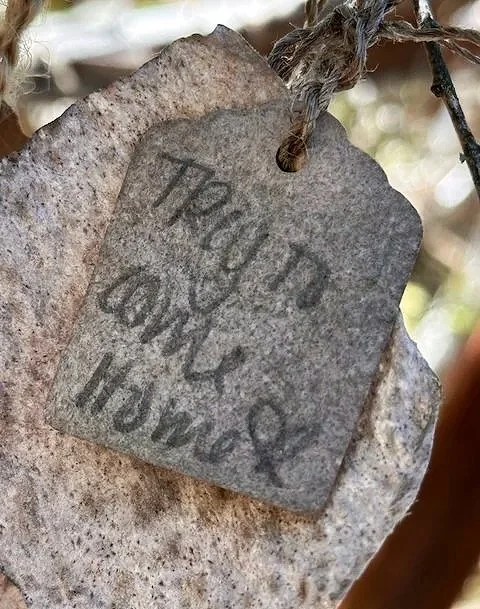
As we strolled, we came upon the wishing tree whose branches are hung with touching messages handwritten on brown paper slips. We paused to read the wishes and found them to be a poignant form of poetry, a quiet litany of longing.
I wish my grandpa would get better.
I wish for a sleepover for my birthday.
I wish for a bigger bike and to be healthy.
I miss my grandma.
I will find inner peace and light to find my destinations.
I wish my family was all together.
I wish for my green card.
Try to come home.
We walked further along magical trails, entering the hut whose earth floor was dappled with sunlight, and passing a wooden airplane once piloted by my grandson in his toddler adventure days. In the shade of a nearby tree, a group of preschool children were resting on the ground for nap time. The smallest child was held in the arms of a young woman with long golden hair wearing a white dress, like a fairy tale, I swear. And another woman was humming a lullaby--a haunting, lovely melody that hovered in the air. The world was timeless, and we were here.
I’d like to say we emerged with a definite plan for what to do next, but resistance and transcendence entail gradual processes and multiple branches, with inconsistent visibility ahead. All I know is that our cause is just, our commitment is real, and, as it says in the song Jan is writing: “It’s not too late.”
I found further guidance in a poem by Stuart Kestenbaum, which reads, in part:
Gather up whatever is
glittering in the gutter,
whatever has tumbled
in the waves or fallen
in flames out of the sky,
for it’s not only our
hearts that are broken,
but the heart
of the world as well.
Stitch it back together.
We are seamstresses, storytellers, spinners of dreams, stumblers and strugglers, stepping on air, no longer young but ablaze with anger and lit by love, and the pool of our allies is vast and expanding, and we will not go gently. I wish for the return of decency and kindness to our country. I wish for a better world.
______________________
A NOTE FROM CYNTHIA: Please step out on March 28, 2026, wherever you happen to be, and help make the nationwide, nonviolent “No Kings” protest the largest in history. Your presence makes a difference. Let us demonstrate the will and power of the people in epic numbers.