Nevertheless
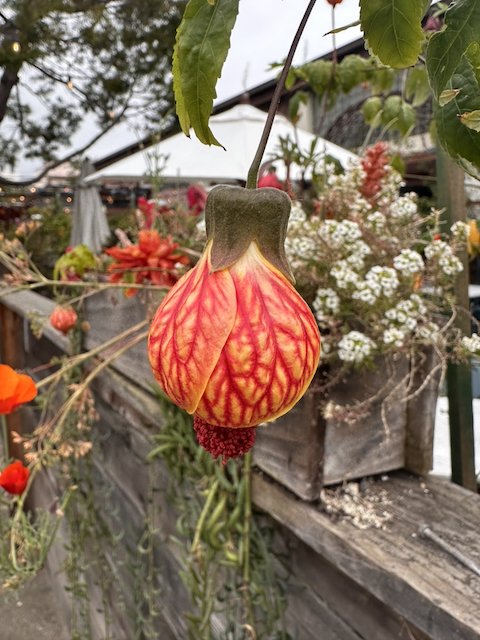
I walk in wonder and curiosity, collecting images, gathering fragments of voices and sounds, feeling the air, as my grandson would say. This is how I soothe myself. It’s therapy.
Last week, I walked along the mission trail, on the bike path, and through the back streets of town. The postman in his white van was whistling along to country western music. At a bakery in Solvang, I learned that the head baker is Armando, and he bakes the dense, fruity muffins that bear his name. There are five shy horses behind a fence now near the mission, daring to come a little nearer each day. On the bike path, someone has painted the word, DANCE, all in caps, more command than option, but I can’t. I run into a friend who is walking her dog and ask her what the meaning of life is. She says, “Fly first class if you can.” (This feels very true in certain situations.) I see a winding creek, an old wooden farm house with faded paint, a large crow taking wing from the branches of a tree.
In Santa Barbara that afternoon, three plump pelicans are paused on the boardwalk, completely unafraid, and there’s a sand sculpture of a rubenesque woman reclining on the beach. On the front wall of a white stucco building adjacent to a palm tree, someone has written a terse graffiti message in thick green spray paint: Fuck Ice. The farmer’s market is happening on State Street, an explosion of flowers and piles of picturesque produce, and busy vendors are weighing and bagging and counting out dollars. We walk to the Courthouse, the very place where Monte and I were married, and we take the elevator to the top and look out at red tile roofs and the mountains beyond, and down into the garden below where a wedding is taking place. We encounter the newlyweds afterwards and tell them that we were married there 42 years ago and–look at us–we’re still together, and the bride’s eyes fill with tears. “Now I feel that I’ve been blessed,” she says.
I chat with the sweet docent lady in the lobby; she wears a turquoise knit sweater and round spectacles, and she has been a volunteer here for decades, watching newlyweds and tourists come and go. In the mural room, we scan some centuries of California history as depicted on the painted walls. We hear the echoes of foot steps in a cool dark corridor, and head back onto the street outside. There’s an actual mobile library out there—a whole van filled with books and staffed by two earnest librarians guiding folks to reading discoveries. We look at landscapes in a gallery, and wind chimes and crystals in the metaphysical book store, wend our way past a tangle of streets and crossings and eventually climb stone steps through the campus of the community college, then back to the shoreline.
This morning I found an unexpected comment from a reader of my blog responding to a post from six years ago, early in the pandemic. It was a thoughtful and poetic comment, and I decided to revisit the post that had prompted it. This is what I had written, the post in its entirety:
Here is my new epiphany: hope is a seed that hitchhikes on our souls, and is carried far and wide, and it will take root if given a chance, and something good will grow. Hope is a traveling seed, and I want to be a host. There is no other way.
Strange times. Someone told me that the local Costcos are selling out of toilet paper, face masks, and Pepsi. Priority goods for the apocalypse. And it’s Super Tuesday, with a newly narrowed Democratic field, and the practical advice is to vote for Joe, and hopefully avoid an election day showdown between the orange clown-king and an angry old socialist who promises plenty but can’t deliver.
My tribe is traveling and checking in. When I last heard from my friend Diane, she was hurdling down Route 66, two hours from Amarillo. Kelley and Bill left this morning for New Zealand, Cornelia is in Berlin, and my daughter is in Paris. Connect these dots and a thousand others for a map of my heart. Thinking bigger still, these words of astronomer Jill Tarter come to mind: “We are part of a billion-year lineage of wandering stardust.”
All interconnected, I am certain of it. Light in search of sense, perhaps. But as individuals, we are not given the luxury of time, and so we are obliged to write it down, pass it along, remember, stay true, and build upon the learning. How is it that we have strayed so far?
Hope is a seed, clinging to me now, and may it catch onto you as well. Let’s share stories and find fecund soil and grow a small, good start to better days.
________________
A lot has happened in the ensuing six years. I don’t know if stores are still running low on toilet paper, and I see very few people in face masks lately, and I have come to respect and appreciate Bernie, but I was certainly right about the orange clown-king, although I would use a stronger term now.
And the messages I gleaned, the epiphany, these still hold true.
The wise and insightful Robert Hubbell has observed that a psychic wound has been inflicted on American democracy that will take a generation to erase. It’s hard to hear this, but it is the truth.
A young friend in his 40s said something to me recently that broke my heart: “I’ve been witnessing the thread being pulled from the American sweater, to where it’s just a pile of yarn on the ground right now. It’s embarrassing what the world sees us as.”
I refuse to believe our story ends in a sorry heap of unraveled threads, but this is certainly a scary and disillusioning time. I do indeed feel traumatized, wounded on a psychic level. And yet sometimes I also feel weirdly energized, determined, in love more than ever with the ordinary and astonishing ways that we are human, and this magnificent planet in need of our cherishing.
So I stand by these words I wrote six years ago:
Hope is a seed that hitchhikes on our souls, and is carried far and wide, and it will take root if given a chance, and something good will grow.