At The Launch Pad of Souls
On my first night here, I was abruptly awakened by a presence, a being standing over me. I became aware of it initially as a movement, then a stillness, a streak of white vaguely reminiscent of a snowy egret gliding towards water. As it drew nearer, I realized it was human-sized, even large, and it was startling, but not threatening. It hovered, then stood still and silent, looking down at me. I could not read whether its gaze was tender or indifferent. Perhaps it was just curious. And I do not know how long it lingered, but I was not afraid. It was simply a being, here in its own realm.
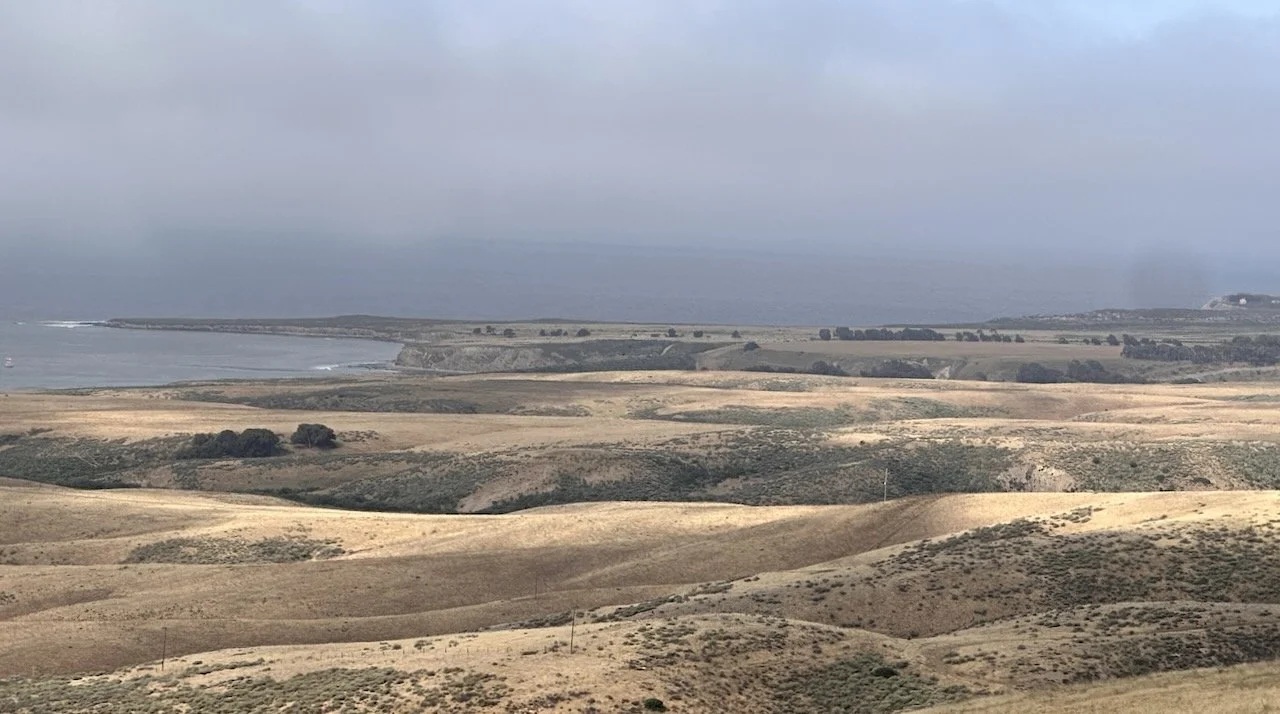
I was the outsider, adrift in someone else’s bed at the far western end of the Ranch. We were staying at the house of a friend in the hills overlooking Point Conception, a sacred place for the ancient Chumash, a gateway for the souls of the dead to enter the heavens and begin their celestial journey into the afterlife. The area does have a spiritual feeling, and this was palpable even before the visitation I just described. It’s windy here, and wildly magnificent, a culminating place, a place somehow of drama and echoing peace, an end that leads to a beginning. The grassy hills are sun-bleached to a yellow brown, and the undulating landscape curves as it meets the sea. From where I sit right now I can see the long finger of Government Point reaching out towards the south and east, and west of that, the familiar mound where the lighthouse is.
This is the edge of the 14,000-acre Ranch, which is where we lived for decades, and it’s strange to be here in this new context, as visitors and guests. It’s hard to explain how a place can be so familiar and dear and at the same time so alien and surprising. Certainly, we have changed since our vibrant days here: we are no longer young, and we’re currently navigating challenges and uncertainties that underscore our fragility and awareness of mortality.
The Ranch too has changed, not the fundamental landscape of it, which, though continually reshaped by weather and geology, is steadfast in its splendor, but in the culture that prevails, and the stories that are remembered or forgotten.
We visit with a few old friends. We reminisce about the lucky kids who grew up here, about storms that stranded us, adventures that bonded us, the old-fashioned sense of interdependence and shared wonder. We recognize remnants of the community we once knew, but it’s different now. Those who have stayed confirm this.
One morning I take a solitary walk, up and down steep hills, silence but for the crunch of my shoes on gravel and the hum of the brush, roads bordered by dry stalks of thistles, a muddy ravine, long views of mountains entangled with shreds of cloud. It has never been easy to describe this place. As my daughter puts it, the Ranch’s beauty has always seemed “slightly out of reach, incomprehensible or illegible—something felt rather than described.” The closest she can come to it is with unadorned nouns: cows, birds, wind, waves.
“The words become objects that hold meaning,” she has written, “like the shell, the stone, the sea glass.”
But what is the meaning? And why must I ascribe a personal message to what I see before me: in this very moment gold hills rolling like a shimmering carpet to a very blue sea, a tree whose leaves are trembling, a leaning fence weathered into driftwood. And why am I struggling to figure out how I fit in here? No longer a resident, no longer an owner, but did any of this ever truly belong to me? What does it matter anyway?
We are ostensibly staying here to tend to our friend’s cat, but in truth he has given us a generous gift, a retreat to someplace dear to us, a chance to pause and reflect, then continue in our decline and reinvention. The cat’s name is Winslow, and he is a gargantuan feline who leaps onto the bed and rouses me from dreams by stomping all over me, playing with his jingle-bell toy, and purring loudly in my ear.
Awake, I see a circle of the night sky through a large round bedroom window. I climb out of our friend’s tall bed, and step gingerly across scatter rugs and unfamiliar turns to the bathroom, careful not to trip. I violate my own resolution and grab my phone for a quick round of doom scrolling, then try to resume sleep, hoping Winslow is done playing.
In the morning, I walk up a hill to a high point on a bluff with views in all directions, and in my own way, I proceed to pray.
The mountains are a distant zig-zag of dark silhouettes in the morning haze. The ocean is a shine of silver. A train passes through—I cannot see it, but I hear its muffled chugging and the lonely sound of its horn, iconic and familiar, evocative of many remembered nights. The yellow-brown grass of the fields is muted and frosted by fog, but the fog is gradually drifting and dissipating into white clouds that open to small portals of blue. A distant ridge is gilded with a lemon slice of sunlight.
Lately I have been saying that I don’t feel like myself, but now I don’t quite know what that means, for my self is fluid, un-contained.
“When I let go of what I am, I become what I might be,” said Lao Tzu. I guess I’m in the process of becoming.
And my self was shaped for many years by this land of miracles.
“But it was never ours,” said an old friend who understands.
My prayer encompasses gratitude, apology, and a good deal of asking, then disperses like the fog into the mystery, but for the moment, I have a sense of peace.
Nothing is lost. This place did not belong to me as much as I belonged to it, and now in my exile, I walk on air, inventing possibilities, and somehow my soul is now but also then, there and also here.
The mysterious night visitor has not returned to stand over me, but I believe we will meet again.