The Story Has Not Ended
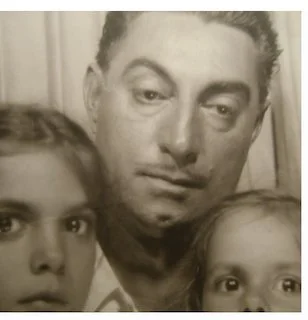
My father was born on this day, March 29th, in 1911. He has been gone for nearly fifty years now, although “gone” is probably not the right word to use for someone who is such a constant presence in my heart, my head, and in my DNA. On this particular Sunday, 115 years after his birth, I am buoyed a bit by the historical protests of yesterday, but at the same time feeling overwhelmed and sad, wondering what my father would think of all that has been happening in this strange world that he would barely recognize. My own default state is one of bewilderment, but it is clad in dogged hopefulness, and even if I don’t always know what I’m supposed to be doing, I know what matters, and I refuse to give up, and I’m pretty sure this would have been my father’s attitude.
He was born in Brooklyn just a few days after the horrific fire at the Triangle Shirtwaist Company in Greenwich Village that took the lives of 146 workers, most of them young women, recent immigrants trying to make their way in a new country whose promise was difficult to access. I imagine the newspapers were still filled with the details of that tragedy and its aftermath when my father was an infant in his mother's arms. I try to picture the city as it must have been then, with its tenements and brownstones, peddlers and shopkeepers, street cars and horse drawn carriages. The New York Public Library Building on 5th Avenue was dedicated by President Taft that spring, and the song on everyone's lips was Alexander's Ragtime Band. Madame Curie won the Nobel Prize in Chemistry for the discovery of radium and polonium, Italy attacked Libya, and the first U.S. transcontinental flight was completed...from Sheepshead Bay to Pasadena in 49 days.
When my father was a boy, in fact, airplanes were still rare and exciting enough to cause everyone to stop what they were doing, point upward, and stare in wonder. The airy-plane! That's what they would sing out...the airy-plane... (He told me that himself.) He was the son of an immigrant from Naples and a first-generation Italian-American girl. He grew up in a rough neighborhood, the eldest of three surviving brothers, and he was tough and smart, but he had a lot of responsibility thrust upon him. He was expected to tend to his younger brothers and their ailing mother while Pop took to the road on mysterious business trips that lured him from New York to incongruous destinations like Kansas City, which may as well have been on the moon. At eleven years old, he became the family scribe, sending letters in care of General Delivery about progress at school, unanticipated household expenses, and a baby brother who toddled into the front room calling for his poppa. Written in a neat fledgling cursive and signed with his nickname, “Sonny”, the letters inevitably went unanswered, but they must have mattered – two of them survive to this day in a safe deposit box filled with things I deem treasures that will no doubt baffle my daughter when she one day comes upon them.
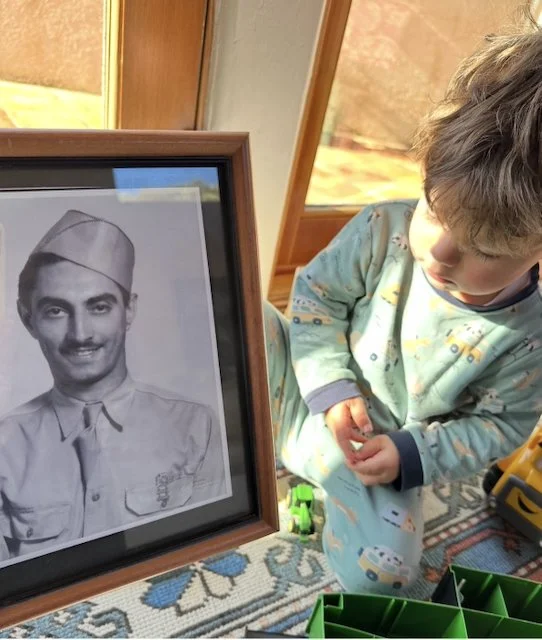
The pattern of being the responsible one continued throughout my father’s life. He was brilliant and eloquent, and he yearned to go to college, but the opportunity was not available to him. He spent some time in the military during World War II, stationed at Camp Cooke, and married my mother in the 1940s. Six kids, a great deal of struggle...he shelved his own dreams to take care of everyone, and he picked up the buckets and brushes he had hoped to leave behind, painting walls and murals in rich people’s houses. I remember him going to night school when I was a child, attaining a degree as a Doctor of Chiropractic, and the discipline and effort that must have taken is humbling to contemplate. But still, he rose in the pre-dawn hours, donned his paint-splattered overalls, and left us safe and sleeping.
He seldom bought anything for himself. A bag of candy, perhaps – he liked those orange sticks covered in dark chocolate. And once he went to Little Italy and came home with a couple of Italian records. One of them was Renato Carosene singing frivolous tunes like Tu Vuo' Fa' L'americano. He got a kick out of those. Another was an LP by Luciano Virgili, songs with names like Piccola Santa and Addio Signora, somewhat maudlin, yearning songs about love and loss—Italian schmaltz, as my husband would say. But I believe those songs were part of my father’s true essence, a deep-rooted sentimentality and sadness that the demands of his life would not allow him to linger on. Chocolate and opera were luxuries, and his own proclivity for prose and even poetry was a secret. Life was a battle.
A memory comes to me of a winter day with my father in Manhattan. How is it that I had him to myself that day? There is a jangle of traffic, city noise, gray sky, gray buildings, the marble steps of an imposing façade, maybe a bank. We are hurrying, and it’s cold, and he buys a small paper bag of hot steamed chestnuts from a vendor on the street, and I hold the bag up close to my face and feel its warmth. I am a gap-toothed girl in a red and white striped scarf and a blue coat missing two buttons, my ears are cold and my nose is running, and there’s a sense, as always, of worry and hurry, but the chestnuts beneath their hard brown skins are buttery and satisfying, and I am here with Daddy, safe and loved. I wish we didn’t have to go home, where this glorious day will end in a fight, where the best in him will be misunderstood, where all the proclaimed turning points will take us in circles and the patterns will repeat themselves into hopelessness. I wish we weren’t heading for the things I know about now.
“He who mounts a tiger cannot dismount,” was one of his sayings. And so he never quit, working through the last day of his life, teaching and guiding, cooking for the family, painting flowers on the walls, making everything more beautiful, loving us fully and unequivocally, and imagining so very far beyond what I could see.
Because he was a writer, I can still read his words, and sometimes I find counsel in them to help me navigate the present. “Your object is survival,” he wrote to my Uncle Joe, who was stationed in the Pacific during World War II, “not merely within the strict limitations of the word, but more -- survival in the best manner possible. Not to emerge a sad sack, forlorn and beaten into submission by adverse circumstances. Not to come back an unreasoning savage, wild and hostile to each and all, eager and ready for revenge. But to come back with balance, with a reasoning mind, to hate your enemies and to be on the alert for them, to respect your friends and appreciate them, and to love those who love you...”
He contained contradictions. Though he described himself as a cynic and often spoke like one, he burned with passion, ambition, and desire. “My God damn mind insists on analyzing, weighing, thinking, scheming…” he declared, yet elsewhere he wrote about “the heart that sings its wild poetic song” -- so plainly his own.
He wrote to me directly, too. Some of those letters sting because I know I let him down, and that fact is painfully apparent in every sentence. I held great promise, and he loved me very much, but I was selfish, misguided, and stubborn, as young people often are --- and then he suddenly died. I didn’t get a chance to make amends.
“In the end, nothing matters but who loves you, and how they perform in this.” He wrote those words to me not long before his death. I was in my twenties then, childishly accepting any help he could provide, while rejecting advice and criticism. I was trying to figure things out in my own way. I couldn’t explain myself, even to myself, and I don’t think I understood what he was telling me. And I certainly did not know how little time there was.
But he also told me this: “It is possible to keep both feet on the earth and still have your head in the stars.” Was he warning me, or advising me to do that? Today I am quite certain that what he meant was that I, who was then so erratic and ungrounded, should create a practical infrastructure but not give up my ideals and aspirations. And that’s my scripture now.
We are being tested in this moment. The wrong people are in charge, generating cynicism, cruelty, corruption, and chaos. The values and precious blessings for which our forebears fought are being trampled. An unnecessary war has been unleashed by incompetent people who view it like a video game, children have been killed, the very planet is at risk, and a propaganda machine pumps lies, nonstop, into the heads of millions.
All the struggle, all the courage, all the dreams cannot whimper away into this. No, we won’t allow it.
On my father’s birthday, I hereby resolve not to be beaten into submission nor relinquish my heart’s wild, poetic song. And I don’t know what tangible form our efforts to right the ship of state will take, but we have the compass and we have the drive, and yesterday I saw again that we are manifold and strong.
Meanwhile, I have learned to walk on air as well as earth, and I’m making peace with my befuddlement and finding a weird kind of freedom in being unmoored. The fact of missing my father has become such a fundamental part of my being I don’t know who I would be without it, but I try to do good things in his memory. No one lives in vain who has changed someone else for the better. And the story has not ended.