We All Know That Something Is Eternal
It was a week of joy, relief, and hope. Yes, we have a long, messy road in front of us, but America has unequivocally repudiated the cruelty, corruption, and chaos of the most incompetent presidency in our history and his cadre of enablers. And now the next phase of work begins, but how remarkable and exhilarating it is to have arrived at this junction! It feels good to feel good! Let’s take a moment to feel it.
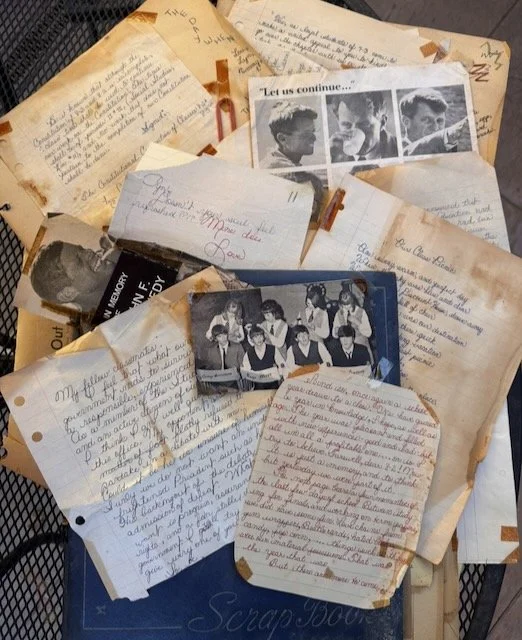
And while I was paused in this sweet interval of feeling it, a strange thing occurred. A large cardboard box appeared at my mailbox. It had been shipped to me by my brother in South Carolina and contained two large scrapbooks from my junior high school days, 1963 and ‘64. I'm not sure how they ended up with him, and it was thoughtful of him to ship them to me--apparently, he is in the process of cleaning up and decluttering his house. But it was mind-boggling and peculiar, like opening a time capsule into my adolescent days.
There are journal entries in my teen-age cursive, souvenirs from the 1964 World's Fair, notes passed in class, newspaper clippings and shreds of a poster from when Bobby Kennedy (the real one) was campaigning for New York Senator and came to our town, and I got to shake his hand. There are silly, cringeworthy letters, scripts for skits, attempts at poetry, fragments of pencil drawings. There are candy wrappers that apparently had significance, meticulous notes for my term paper, birthday cards and party invitations. There are movie schedules and the flattened container that held my popcorn when we went to see Strait-Jacket on January 30, 1964. There is a lease for the property I owned in the back of our social studies classroom when we created a government and a town, and copies of my campaign speech when I ran for class president, and audacious requests to Mr. Ginsburg (more about him later) for test postponements and additional in-class time to develop our class constitution. There are heartbreaking magazine photos of JFK and my own written thoughts in the aftermath of his assassination. And who knew I was such an obsessed fan of the Beatles, Paul in particular? Let’s face it. I was a ridiculous, sentimental, typical teen in the Long Island of the early 1960s, but a highly verbal one with an impulse to document and collect artifacts. (Hmmm.)
One of the events that is immortalized in here was watching the performance of a school play. It was, of course, Our Town by Thornton Wilder. (Is there a school in America that did not mount a production of Our Town during this era? Is it ever chosen now?) Anyway, I must have been inspired. I pasted in a booklet about it, a list of cast members, and various quotes, all of which seemed weirdly appropriate and prescient as I scrolled through the crumbling pages of the album.
For example: “So, friends, this is the way we were in our growing up.”
It certainly was.
And this: “We all know that something is eternal. …There’s something way down deep that’s eternal about every human being.”
I knew this even then.
Most of this stuff is headed to the trash, but it’s been an epic archaeological dig, and some of it seems meaningful somehow, so I’m going through it slowly. I admit that exploring this stage in the formation of my own identity is slightly delicious in a narcissistic way, and I do already see the core of an idealistic young girl who liked to write, who could be funny, smart and even noble, but also petty and unkind. (Classic middle school, I guess.) But my giddy well-adjustedness surprises me; I didn’t remember myself as being so fond of school and so enmeshed in its social aspects. Then again, our family had just moved from the city to suburban Long Island, and I am sure I had a sense of new beginnings, an illusory belief that things in my world were about to become the way they were supposed to be, and in a strategy that remains my default, I proceeded to make this feel true.
Beyond my starry-eyed teen-aged self, one of the most important people in these junior high school albums is my social studies teacher, Mr. Ginsburg. He saw us as interesting people, and wanted us to know a wider world. He took us on outings, taught us about history and government and civics in action, gave us a sense of our own possibility if we were willing to step up. I had never had a teacher like that before. He was beloved by so many of us (and he died at the age of 85 in 2019) but I am glad to say that at some point in the 1990s, I wrote to him to acknowledge his importance in my young life, and we began a correspondence that lasted several years. I was about to obtain a teaching credential at that time, and I still have his wise counsel and encouragement written on lined yellow legal pad paper. The lesson in all this: as a teacher, or in any capacity, never underestimate the impact you can have on a young person. That’s one of the messages I discovered inside this cardboard box.
I am also struck by the emphasis there was back then on governance and civics. We learned about the branches of government and the Constitution, then drafted our own, formed a government, elected officers, and turned our social studies class into a country. We began to view ourselves as citizens, and we went forth into the world with some sense of the responsibility and privilege this entailed; the word “citizen” became an active verb. (I would love to see this focus resurrected in our schools.)
History was happening and we were not separate from it. The clippings, writings, and pictures I found are evidence that we were truly touched by news events. On a sheet of loose leaf paper dated September 1963, I see my weekly current events report: Alabama Governor George C. Wallace had closed three Birmingham public schools scheduled for court-ordered desegregation. There is a poignant tribute to President Kennedy written in the days following his assassination. A 1964 campaign poster urges “Vote for Johnson, Humphrey, Kennedy: November 3, Polls open 6 a.m. to 9 p.m.” It is not hard to perceive the continuity of history from those days to the present.
The personal teenage memorabilia are perhaps more trivial and quaint, but in these I see the appetite for social connection, the relishing of experience, and the vibrant spark of astonishment. It also reminds me how life, over time, is turned into story if transcribed and lit by the light of imagination.
And here we are, one week after the midterms, standing in the interval of joy and hope, knowing we stepped up, and gathering strength for the struggle ahead.
And everybody knows that something is eternal. Let us continue.