Pollyanna
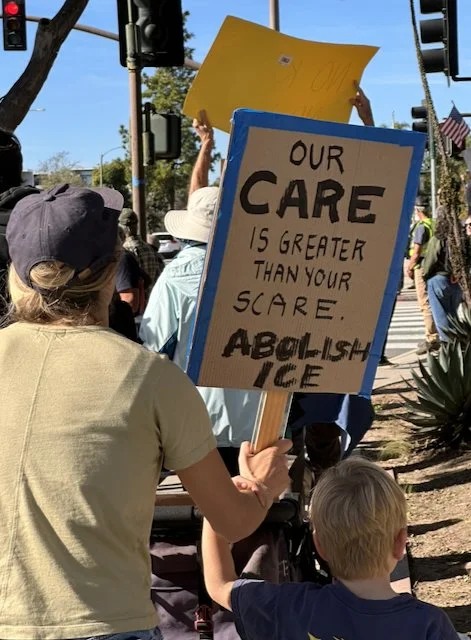
I’m sitting in Irene’s car with three other women and we’re driving over the San Marcos Pass to participate in a protest in Santa Barbara, organized by Indivisible. We’re in our 70s and never imagined that we would be spending so much of our lives at this point going to rallies and calling Congressional offices and writing postcards to voters and listening in horror to daily updates. We realize we are privileged to be able to do this, and I’m grateful to be part of a network of wise, kind, and mutually supportive friends, but it can be exhausting and discouraging. Rebecca tells me that one of her oldest friends, an educated, Left-leaning thinker, dismisses such protests as useless and called her a Pollyanna. It stung a little.
I, too, have been called a Pollyanna, long ago and recently. But I’ve decided to own the term. It goes back to a 1913 novel by Eleanor H. Porter, made into a 1960 Disney film starring Hayley Mills, and draws upon orphan Pollyanna’s habit of playing the “glad game”, in which she seeks and finds the bright side of every situation. And of course it can be ridiculous, even offensive, when taken to the extreme, denying or diminishing adverse realities. I don’t think there is any gladness to be found in the abandonment of our Constitution, the intrusion of masked thugs into our cities, the murder of an innocent woman.
But as a Pollyanna, I am also noticing the positive fervor and solidarity in the response, a renewed devotion to our values, a reawakening.
“Trump doesn’t care how many people take to the streets in protest,” said Rebecca’s friend. But that isn’t the point at all. Representatives who want to remain in office take note of it. A theory in political science suggests that when 3.5% of the population of a country protest nonviolently against an authoritarian government, that government is likely to fall. And prompted by outrage and heartache, we are finding one another in community and rediscovering the power we possess.
It’s all too easy to mock Pollyanna. “Be cool like me,” says the cynic.“Do nothing.” But it turns out that being Pollyanna-ish can be a healthy coping mechanism and a viable strategy for making things better. Conversely, deciding that a situation is hopeless immediately precludes good outcomes, and silently acquiescing to injustice and brutality only empowers the authoritarians. Despair is a self-fulfilling prophecy, and cynicism is a cheap poison lapped up by the lazy. We must avoid cynicism at all costs.
No one has written as eloquently about optimism and hope as Rebecca Solnit. Hope is not false optimism, she explains, but an active and fierce commitment to the future, to the possibility that we can make things better. Hope is based on the premise that we don’t know what will happen, and that in the spaciousness of uncertainty there is room to act and influence outcomes.
“Hope is not a lottery ticket you can sit on the sofa and clutch, feeling lucky,” she writes. “It is an axe to break down doors in an emergency. Hope should shove you out the door, because it will take everything you have to steer the future away from endless war, from the annihilation of the earth's treasures, and the grinding down of the poor and marginal...To hope is to give yourself to the future…”
And so, in our little red car, we drove over the pass into Santa Barbara and joined about two thousand fellow protesters along northern State Street. Signs were blunt: ICE Domestic Terrorists; Same Shit. Different Hat; Our Care Is Greater Than Your Scare; When Power Goes Unchecked, People Die; IT WAS MURDER; Believe your eyes, not ICE lies.
A strand of a Woody Guthrie song wafted through the air from a portable speaker. This land is your land, this land is my land… There were chants of “This is what democracy looks like!” Passing vehicles honked their horns in support. (Well, all but one, in which the scraggly-bearded young driver of a U-Haul truck shouted, “Grow up!” and sped away. How sad it would be to grow up into that. Don’t worry. We won’t.)
A week earlier, I had driven to Nojoqui Park to walk to the waterfall. In the aftermath of constant rain, it was sure to be a spectacular destination, but I also just needed to get outside and clear my head. The trail was wet and muddy, thick with the mulch of damp decaying leaves and broken branches, slippery at times. I wished I had brought a walking stick but I stepped along gingerly, surprised by the number of people out there: parents carrying babies or holding the hands of their toddlers, Gen Z’s with tattoos and piercings, a conspicuously pregnant woman, a pair of Spanish-speaking aunties, a bearded old guy in a bike jersey…a motley procession of strangers all drawn by the same impulse, to behold something wondrous, and stand in awe. It was very like a pilgrimage, and it felt good to be a part of it. A woman saw me wobbling and handed me the branch she had been using as a walking stick. I gave it to someone else at the end of the trail. The Pollyanna in me was very pleased.
“We need a hero,” said a friend of mine. But I look around and see heroes everywhere. There is so much kindness, so much caring, so many voices speaking out. I see food being collected for hungry neighbors, and songs being written, and young people being tutored and coached and guided along bewildering paths. I see fledgling activists doing what they can, and diligent, decent people forgoing their Saturday morning leisure to protest the cruel and unconstitutional acts of the current administration.
I love this passage from Tolkien’s Fellowship of the Ring:
“I wish it need not have happened in my time," said Frodo. "So do I," said Gandalf, "and so do all who live to see such times. But that is not for them to decide. All we have to decide is what to do with the time that is given us.”
This is our time, dear friends. I have been writing this blog for about twenty years, and I’ve covered some difficult topics in my musings, both personal and universal: the pandemic, the aftermath of my acoustic neuroma surgery, confusion and change, age and loss. But I have never been as snagged and dismayed as I am at this moment in the history of our country. If your heart is in shreds about this, as mine is, I feel you. But I have come to believe that democracy will be saved by everyday citizens who have decided to resist, stepping outside their comfort zones, honoring the struggles of their forebears, and wanting their grandchildren to grow up in a country that is free and kind. We need to hold things together, keep doing what we know is right, vote like our lives depend upon it, and draw in some of the millions who did not vote at all. Call me Pollyanna, but maybe we will emerge even better than we were, chastened by what we almost lost, ferocious in our love.