Interiors
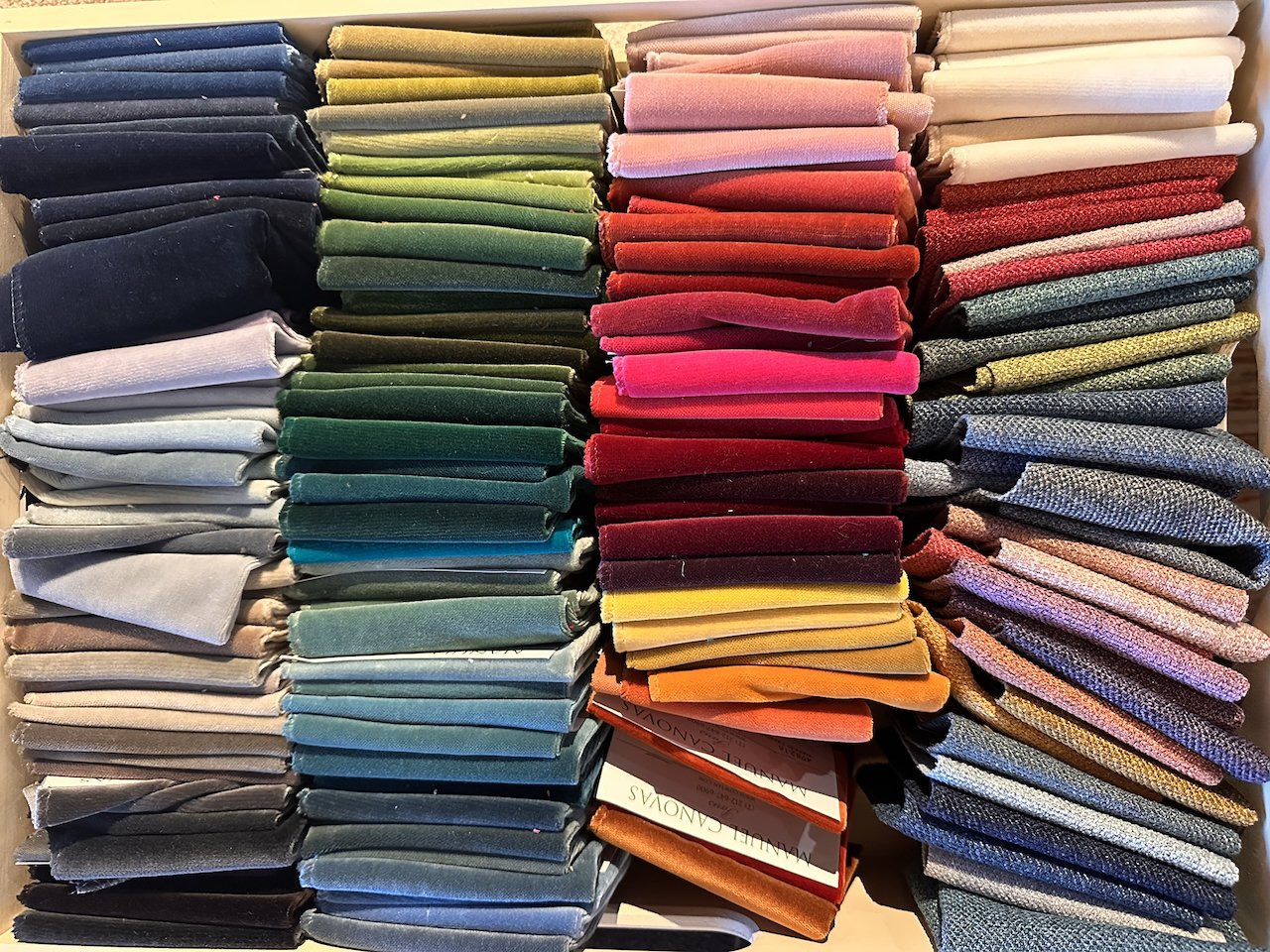
The designer brings us photographs of furniture and an armful of fabric swatches that open like an accordion and fan out on the table. I enjoy the colors and the textures, and I marvel at the names, because there is never a simple word like blue. The tones we see are sky or indigo, sage or charcoal, sienna and rust and vibrant teal. A textile with a bumpy surface is called Oats and Barley; an assortment of soft square swatches are Sumptuous Velvet—a material described as “exquisitely understated.” I am completely out of my element, but I allow myself to imagine entering our living room and sinking into a luscious curved sofa covered in Vienna Velvet with a pile of plush pillows playfully heaped on top.
We sold our house with all its furnishings and now we dwell in a capacious, nearly empty space. Through every window there is beautiful light and views of mountains, trees, and sky, and in the month since we moved in, I have come to develop a deep appreciation for the place, even in its current state. There is more possibility, after all, in vacancy than clutter. But our books and paintings are boxed in the garage, my clothes are heaped in a large plastic tub, and we eat at a borrowed card table. There’s a newlywed feeling to it, a sense of adventure, a liberating leap into something different that is yet to be defined. But there are days when this unsettlement feels awkward and uncomfortable, and I look forward to the time when we can relax with a sigh in a finished and furnished space.
Meanwhile, I’ve discovered that Monte is more adept than I am at visualizing décor, and I’m fascinated by his fluency in decorator dialect and how readily he grasps the suggestions of the woman who is helping us. I’m bewildered by all their ideas, quite fond of the old Turkish rug we brought from the other house which apparently no longer “works”, and I’m perhaps a little less appalled than others by the mammoth dark wood desk left over by the previous occupant of this house—it looks like it was taken from the office of an insurance executive in Syracuse, circa 1975, but it’s functional for now. I’m just more willing to make do, I guess, and when I look back upon the places I grew up in, I can see the source of my ease with the haphazard.
My childhood home, throughout the 1950s, was a railroad flat on Coney Island Avenue. Whatever furniture we had seems to have always been there—maybe it belonged to my father’s mother, who had lived in that very apartment before us or in a building nearby. My father, however, transformed the walls. “Artist and Decorative Painting” said his business card, and we looked up at walls adorned with flowers and leaf sprays, marble effect, and unexpected murals. I remember the large face of a clown next to a bookcase, and a peacock on the wall above the kitchen table.
In the early 1960s, we moved from the city to a small house on Long Island. It would mean a debilitating commute for my father, and my mother felt exiled and isolated—she was a city girl who never even learned to drive. But it was purchased for $12,000 with a Veterans’ thirty-year mortgage, and it represented the attainment of some version of the American dream. It was a good brick house adjacent to scrubby woods, and we moved in with touchingly earnest hopes, most of which soon crumbled. There was a backyard with potential for a garden we never grew, a fireplace we never once lit, two bedrooms and an attic that was turned into a third. My father’s decorative art was everywhere apparent, from the flowers on the kitchen ceiling to the faux marble veins along the attic stairway. A little purple bird on a blossomed branch was painted in mid-chirp in one of the bedrooms. Over time, some of the wooden dressers were brightly and thickly painted, an effect somehow both festive and poignant. Meanwhile, my mother’s hoarding propensity escalated and gradually took over. Everything was messy, and discord mounted. “He left me out here in the sticks,” she would say, and she too occasionally decorated the walls, but with angry messages written in charcoal. I later learned that the Long Island house burned to the ground in a suspicious fire a few years after my family sold it. I cried a little when I heard that. I don’t know why.
I had left that house as early as I could and moved into a Chicago basement apartment with my medical student husband. You entered by a door in an alley way, and the view from the front windows was of the sidewalk above and the feet of passing strangers hurrying to the nearby CTA station. There were pipes on the ceiling, and the furnishings were the salvaged remnants of an abandoned fraternity house, including a cracked vinyl couch that was supposed to look like leather, and a sea-green wooden bed onto which I affixed pretty decals of butterflies. One day, in a misguided attempt at cheer, I painted the bare floor of one room blue; this proved to be a comical mistake.
After leaving that marriage, I spent a lot of hours on Greyhound buses and on the mattresses of sympathetic friends, and then a series of bleak furnished rooms in upstate New York. There was a period when most of my belongings were in my car, bundled in black trash bags. I was a desperado, but I found my way to California. I got a job in Orange County, met Monte, and the rest is history, a miraculous history. Together, Monte and I made the first home that ever truly felt like home to me.
It was at the Ranch, of course, and I’ve written about it ad nauseam, but that was the house that taught me how to inhabit a space, and how the space in turn embraces, and how you learn the light of every given moment, and the feel of every room. There was a big soft sofa and a plump red armchair, both upholstered by our dear friend Jeanne, who curated lovely textiles. There was a platform bed that faced a window that brought us the sky and backcountry. There were bookcases everywhere, filled with books, and there were paintings, and pictures of people we loved. The floors were warm Douglas fir, covered here and there with patterned rugs, and there was nothing fancy or complicated, but memories in every room, and they were, honestly, mostly happy ones. A little girl grew up there, a sweet dog curled at my feet, and we grew old and tired, but we were in our space together, and it was good.
So, yes, I am feeling uprooted and out of my element, but also very grateful to be here with the person I love in an empty palace of possibility, a place where, already, my friend Jan sang a song at our writers’ group gathering and the acoustics were great, and friends eat pizza at the borrowed card table, and even the blankness says “I can be beautiful” and once again, as Seamus Heaney advised, I am walking on air despite my better judgement.
I think sumptuous velvet in Buffalo Mud sounds intriguing.