Askew. Ajar. Astonished.
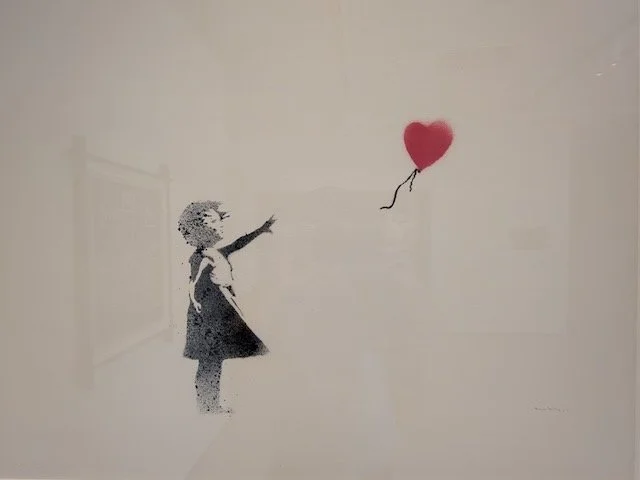
Girl With Balloon by Banksy
I went to a wonderful concert yesterday at a local church. It was music of the 1960s performed by the Folk Orchestra of Santa Barbara, a 30-piece ensemble led by Adam Phillips blending classical strings with folk instruments like the harp, guitars, mandolin, and bagpipes. Our talented friend Bear Erickson stepped up and carried us away on his guitar. The audience was a sea of fellow Boomers, joyful and nostalgic, still imagining, still trying, but surprised, I think, at how the years have flown.
The music lifted me, as music does, and I felt a great surge of warmth and camaraderie for my fellows gathered here. Maybe I got a little tearful at one point.
Monte turned to me. “Your glasses are askew,” he observed. And they were.
But my heart was ajar. It still is. Love keeps pouring in.
A few minutes before the concert began, my friend Karen gave me a book to read during my recovery. It is called The Glorians, by Terry Tempest Williams. I have only just begun to read it, but this passage resonated immediately: “We can reweave the world anew not from the places of fear and doubt, but from intimate spaces of belonging. We are meant to engage, not withdraw.”
Engagement is my tendency lately. I am an empathetic and community minded introvert. I simply cannot ignore the struggles of others and I recognize the sadness; I don’t think life is an easy journey for any of us. Maybe it is a reaction to the daily trauma of the current time—in disbelief and revulsion we wonder what “he” and his sycophants will destroy next. But the good, decent people are everywhere, and we comfort and strengthen one another. We are finding ways to contribute, and we help each other through. And sometimes we share memories and music and remnants of our dreams.
But maybe my deepening connection is just part of getting older, “to love that well which thou must leave ere long,” as Shakespeare put it. I am experiencing the absurd beauty of the world with renewed intensity. There are dazzling glimmers in each day, moments of awe, moments that simply feel holy. Jan and I walked at the Ranch last week and the ocean was sparkling and the road was flecked with shining bits of mica, and the train tracks glinted and bolts of sunlight painted the hills, and we declared it a Diamond Day. We felt exhilarated, hopeful, appropriately amazed.
The writer Annie Dillard has died, and of course I am remembering some of her beautiful prose, in particular this passage from An American Childhood:
What does it feel like to be alive? Living, you stand under a waterfall. You leave the sleeping shore deliberately; you shed your dusty clothes, pick your barefoot way over the high, slippery rocks, hold your breath, choose your footing, and step into the waterfall.…What a racket in your ears, what a scattershot pummeling! It is time pounding at you, time. Knowing you are alive is watching on every side your generation's short time falling away as fast as rivers drop through air, and feeling it hit.
Yes, my generation’s short time is falling away, and I am feeling it hit. But I am interested in the experiences of my elders also. I have two dear friends who are in their 90s. I sometimes feel that they are walking slowly up a corridor ahead of me (by twenty years) but turning around and telling me, with kindness and honesty, what to expect, sort of lighting my way. One lives in Lompoc, and he grows roses and reads poems and has a gift for forging friendships. The other, more isolated, lives out at the west end of the Ranch, and I visited him last week.
“What do you think about, these days?” I asked him.
“I think about loss,” he said. “Not my victories. Only my losses.”
That seemed poignant, and I hoped it was a passing mood. He also talked about his immigrant father, and the value of education, and our shared contempt for you-know-who. He has done good things in the course of his long life and I tried to remind him of this. I think we all need to know we mattered, that we maybe made a difference in the world. I drove away thinking about the courage it takes to be old.
But I was soon distracted by the brilliance of the day in front of me. I drove past what was once Sam’s and Kappy’s place, past the familiar bluffs and seascapes, took a detour up the dirt road where I used to live, and got out of my car to hike up to the sandstone church. The wind was howling so ferociously it nearly knocked me over. But I said some prayers and they drifted into the universe and I felt myself filling with light.
As I walked back, I listened to one of my favorite Jackson Browne songs, The Barricades of Heaven, which is very much an anthem about being young and following one’s dreams, a song about the beginning. It occurred to me that I had just been immersed in musings about being old, thoughts about the end. It seemed that these were perfect bookends to my day.
Here in the middle part of life (actually, more like the last 25% at best) my filter is gone, my boundaries are porous, and I remain astonished.
And one thing I believe, to quote Annie Dillard again, is this: “You've got to jump off cliffs all the time and build your wings on the way down.”
Long ago, when I first heard those sixties songs, they hinted of a world that was different and compelling, a world that I might someday be a part of, but I was new and timid and had not yet grown into myself. Then suddenly the decades passed and I begin to understand that our lives are so unlikely as to be impossible, but we can still dream them into something beautiful, and we might as well be brave. The mistakes I made cannot be undone but they led me to this now, and my glasses are askew, but my heart is ajar, and I am still amazed..