Selling Tommy
There were ponies in picture books and mounted policemen in the park. That was the extent of my contact with horses as a child growing up in Brooklyn, New York. Oh, I suppose I experienced a flicker of horsey romanticism at one point, as all young girls do, imagining myself astride a beautiful Palomino, my hair flying in the wind. But none of the practical details concerned me, and the vision was short-lived. It somehow didn’t go well with sidewalks and snow.
Life, however, is nothing if not unpredictable. Fast forward forty years and I am living on a ranch in a place called Gaviota, driving over dirt roads and a cattle crossing to get to and from my house each day. So the horse fantasies that my daughter Miranda developed, emerging in such a suitable context, didn’t seem incongruous. Which isn’t to say I encouraged them. I simply couldn’t hold them back.
Miranda developed horse lust at age six. Then began the Pony Club servitude, during which my husband and I dutifully transported her to a shabby stable where she spent the day grooming, riding, and cleaning stalls. It was difficult to understand why this was so compelling. She took a ceramics class and crafted a collection of eccentric-looking clay horses. She made pencil sketches of horses, filled spiral notebooks with horse stories, and replaced her dolls with plastic equine figurines. I knew we were in trouble when she got a C in P.E. because she and another horse-obsessed friend refused to run and would only gallop.
The way I feel about horses is this: they are very high off the ground, and I have no desire to sit on one. I like bicycles. They’re more compliant. Horses come fully equipped with a daunting battery of ongoing duties and expenses, and they have voracious appetites– we’re talking, after all, about half-ton vegetarians. In summary, I did not wish to become the owner of a horse. But the relentless lobbying of a young equestrienne is not easily dismissed, particularly when more experienced friends assure you that the horse obsession can delay the boy obsession for up to ten years.
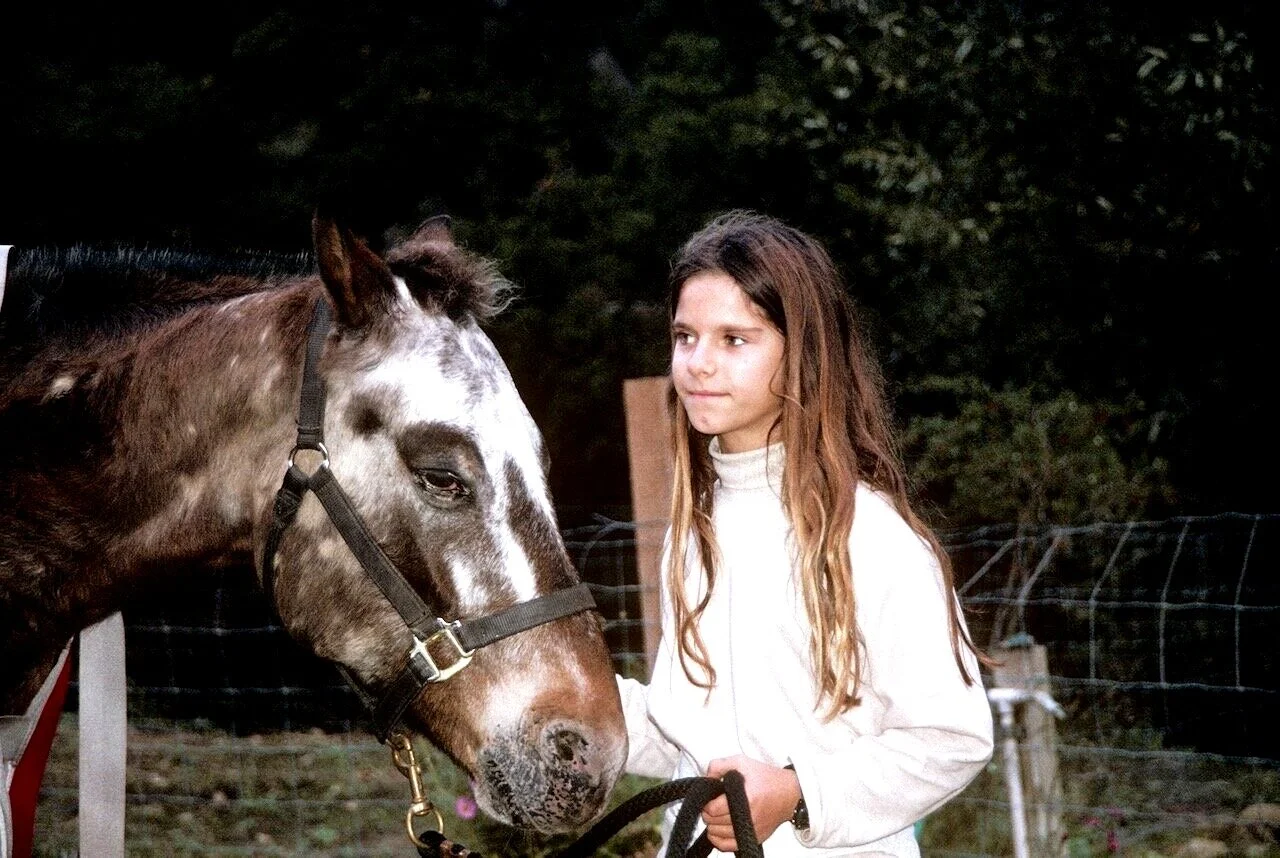
And so we found Tommy – a young Appaloosa who had been raised like a pet. He could hold his own in working cow horse events, and was gentle and predictable enough for the children at the therapeutic riding center where Miranda sometimes volunteered. He had goofy expressions, a horse with eyebrows, one of which arched quizzically when something confounded him. Miranda’s devotion was constant. In the mornings, she would scramble down the hill, open the creaky gate, and walk the trail along the creek to our neighbor’s place, where Tommy boarded. I would glimpse her sometimes, riding in the canyon, my own little girl living a life I could have barely imagined.
Gradually, despite my resistance, it was often me who would walk up the canyon in the mornings and evenings to feed Tommy. It was a simple and satisfying duty. Tommy was clearly happy to see me, and I felt purposeful and appreciated. I liked the sounds of his chewing and chomping. I thumped his dusty flank with tentative affection, and felt the warmth and life in him. We were friends, and I lingered, smelling the sweetness of alfalfa and enjoying the freshness of the air.
Feeding the horse forced me outside. I walked head-on into dusk and morning light, becoming intimate with white sky and the rustle of the brush, with the buckets in the barn, the whims of the well, the latching of the gates, with a thousand sounds and silences I had never noticed, and a thousand kinds of light. Tommy was a good excuse to check out the day before it slid away.
Meanwhile, Miranda was growing up. I watched her help round up the cattle once; she looked serious and competent. Sometimes we’d all go out together – my husband and I on our bicycles, and Miranda on Tommy. Other times, she would take off on her own, just a girl and her horse. I would see her galloping along the rises and contours of the ever-present hills, not awkward and timid like me, but beautiful and capable. Not my little girl anymore, but her own person, a young woman.
And so, as high school and homework and travel and sports increasingly cut into Miranda’s time with Tommy, I knew that she was struggling with the idea of selling him. It was a hard decision, and one she had to make for herself. Ultimately, she simply wanted to do what was best for him. Our neighbor Julie, an expert horsewoman, had grown fond of Tommy, and made an offer. He would have a wonderful home, and he’d be ridden regularly. When Miranda said yes, Julie cried with happiness. Miranda just went quietly to her room. Tommy’s picture was still tacked to her bulletin board, along with some ribbons they won together in the Pony Club days. She resolved to visit him before Julie took him with her to Wyoming for the summer.
Miranda has strength and good sense; I think she’ll be fine. It’s me I’m worried about. I miss Tommy. I miss his quizzical eyebrows. I miss visiting him in the canyon. More than that, I miss that skinny brown-haired girl in her tall riding boots. Come to think of it, I miss my cat, and my Volkswagen bus. I miss my father, too, and the pear tree in our backyard. I miss being ten years old, and the easy way I used to believe that anything was possible. I miss friends who have left us. I miss last year. I miss every summer that has vanished.
I guess you have to get used to losing things if you’re going to live a life. But tonight, the crazy winds are howling, the trees in the orchard are dancing, and I can see Miranda’s light on in her room downstairs. She is reading; she looks up and smiles at me sleepily. I stroke her hair, profoundly grateful for this moment. The sky is ablaze with the milky light of a million obsolete stars.